Occasionally, I will publish short articles in this section. Some of these articles will be expanded upon in Lord’s Cricket Ground in 50 Memorials, while others will serve as additional ‘extras’. The first in this series examines the life and career of Harold ‘Dickie’ Bird, who died in 2025.
Number 1 – ‘Dickie’ Bird
Harold Bird was born in Barnsley, Yorkshire. He left school at 15 and started working in a coal mine. Soon, he left mining to pursue a career in sports, initially in football and later in cricket, signing for Yorkshire in 1956 and Leicestershire in 1960. During his eight-year career, Bird scored only two centuries and was eventually dropped due to injuries, loss of form, and lack of confidence. His playing career ended when he was thirty-one.
Bird became an umpire and stood in his first county match in 1970. In 1973, he umpired his first Test match – England v New Zealand at Headingley – the third and final Test of the series, which England won convincingly. That summer, Bird umpired two Tests in the England v West Indies series. Overall, Bird officiated in sixty-six Test matches and sixty-nine One Day Internationals, including three World Cup Finals at Lord’s in 1975, 1979, and 1983.
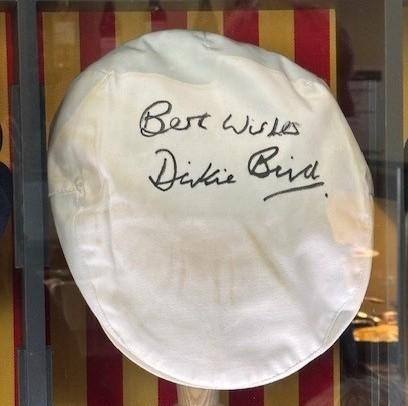
One of Dickie Bird’s caps – exhibited in the Long Room bar at Lord’s
Bird’s eccentricities, good humour, and skill as an umpire endeared him to both players and spectators. At the start of his final Test match in 1996, the England and India players formed a guard of honour for him. An emotional Bird also received a standing ovation from the crowd. However, reality soon returned when, during the first over, he had to give Michael Atherton out lbw. Bird continued to officiate in county cricket for another two years, retiring in 1998.
‘Dickie’ received an MBE in 1986 and an OBE in 2012. A statue of Bird was unveiled in Barnsley in June 2009. Bird died in September 2025 at the age of 92.
Number 2 – Sir Charles Aubrey Smith
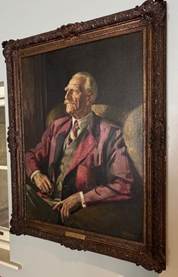
Although not included in my book, the MCC’s collection of cricket-related art forms part of Lord’s heritage. I have highlighted an example here, which can be seen in the Bowlers’ Bar.
Smith (1863-1948) was an English Test cricketer who later became a stage and film actor – typically portraying officers and the English ‘gentleman’ type. A fast bowler, he was known as ‘Round the Corner Smith’ because of his unusual run-up.
He played only one match for England, captaining the side against South Africa at Port Elizabeth in March 1889. In 13 overs, Smith took five wickets for just 19 runs, helping England to a convincing victory. This three-day match, along with others, was later awarded retrospective ‘Test’ status.
In 1932, he established the Hollywood Cricket Club, which attracted other expatriate English actors, including Boris Karloff, David Niven, and Leslie Howard. Smith was knighted by King George VI in 1944 for his services to Anglo-American relations.
A portrait of Sir Charles Aubrey Smith, by John Gilroy