Occasionally, I will publish short articles in this section. Some of these articles will be expanded upon in Lord’s Cricket Ground in 50 Memorials, while others will serve as additional ‘extras’. The first in this series examines the life and career of Harold ‘Dickie’ Bird, who died in 2025.
Number 1 – ‘Dickie’ Bird
Harold Bird was born in Barnsley, Yorkshire. He left school at 15 and started working in a coal mine. Soon, he left mining to pursue a career in sports, initially in football and later in cricket, signing for Yorkshire in 1956 and Leicestershire in 1960. During his eight-year career, Bird scored only two centuries and was eventually dropped due to injuries, loss of form, and lack of confidence. His playing career ended when he was thirty-one.
Bird became an umpire and stood in his first county match in 1970. In 1973, he umpired his first Test match – England v New Zealand at Headingley – the third and final Test of the series, which England won convincingly. That summer, Bird umpired two Tests in the England v West Indies series. Overall, Bird officiated in sixty-six Test matches and sixty-nine One Day Internationals, including three World Cup Finals at Lord’s in 1975, 1979, and 1983.
One of Dickie Bird’s caps – exhibited in the Long Room bar at Lord’s
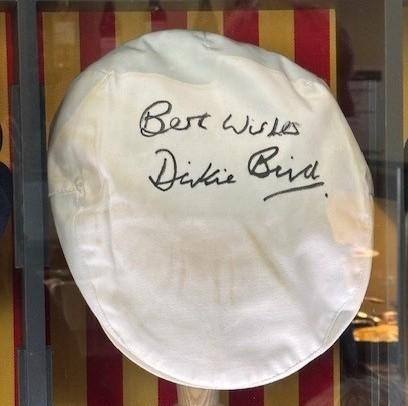
Bird’s eccentricities, good humour, and skill as an umpire endeared him to both players and spectators. At the start of his final Test match in 1996, the England and India players formed a guard of honour for him. An emotional Bird also received a standing ovation from the crowd. However, reality soon returned when, during the first over, he had to give Michael Atherton out lbw. Bird continued to officiate in county cricket for another two years, retiring in 1998.
‘Dickie’ received an MBE in 1986 and an OBE in 2012. A statue of Bird was unveiled in Barnsley in June 2009. Bird died in September 2025 at the age of 92.
Number 2 – Sir Charles Aubrey Smith
Although not included in my book, the MCC’s collection of cricket-related art forms part of Lord’s heritage. I have highlighted an example here, which can be seen in the Bowlers’ Bar.
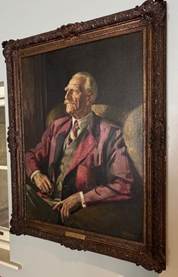
Smith (1863-1948) was an English Test cricketer who later became a stage and film actor – typically portraying officers and the English ‘gentleman’ type. A fast bowler, he was known as ‘Round the Corner Smith’ because of his unusual run-up.
He played only one match for England, captaining the side against South Africa at Port Elizabeth in March 1889. In 13 overs, Smith took five wickets for just 19 runs, helping England to a convincing victory. This three-day match, along with others, was later awarded retrospective ‘Test’ status.
In 1932, he established the Hollywood Cricket Club, which attracted other expatriate English actors, including Boris Karloff, David Niven, and Leslie Howard. Smith was knighted by King George VI in 1944 for his services to Anglo-American relations.
A portrait of Sir Charles Aubrey Smith, by John Gilroy
Number 3 – MCC’s Colours
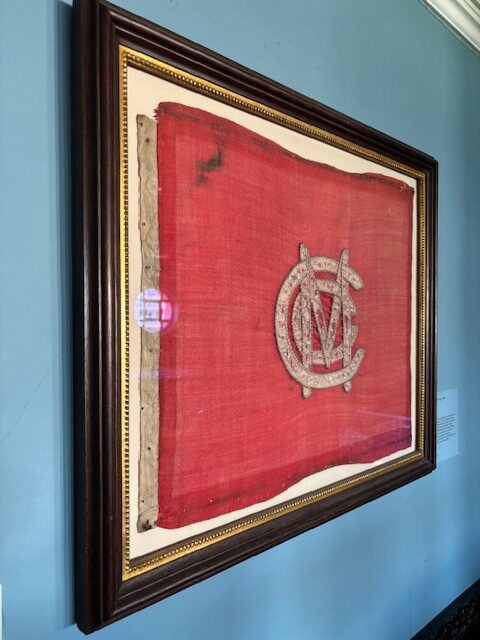
Dating from 1864, this boundary flag is the earliest known object in the MCC’s collection to display MCC’s current colours. Before adopting the red and yellow (‘bacon and egg’ or ‘rhubarb and custard’), MCC’s colours were originally sky blue.
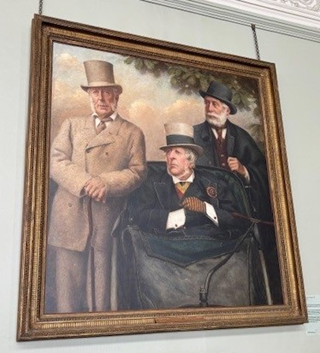
There are several theories regarding MCC’s choice of red and yellow colours. Some believe it is a variation of the I Zingari colours. Founded in 1845, this nomadic cricket club’s colours are black, red, and gold. These colours symbolise I Zingari’s motto – ‘Out of darkness, through fire, into light’. The same colours appear in the cravat worn by the central figure in this 1897 portrait of I Zingari’s founders – (l to r) Sir Spencer Ponsonby-Fane, his brother the Earl of Bessborough, and J. L. Baldwin.
However, the most likely reason for adopting the red and yellow colours was MCC’s association with gin magnate William Nicholson and as a gesture of thanks for providing MCC with the funds needed to buy the freehold of Lord’s Ground. At the time, there was a chance that the Ground could have been developed. Nicholson’s gin bottles featured a distinctive red and yellow label. Later, Nicholson became MCC’s President in 1879, and in 1888, he lent MCC a further £21,000 to purchase Henderson’s Nursery at the Wellington Road end of the Ground.
Number 4 – The Young Cricketer, Lewis Cage,
by Francis Cotes (1768)
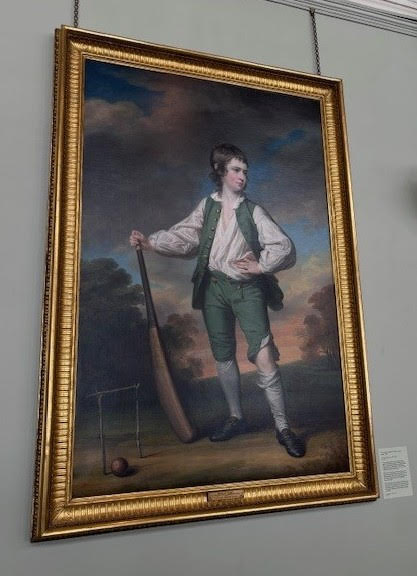
Over the past century, three versions of this picture have hung at Lord’s. Initially, a copy was made by a member of the D’Aeth family, who once owned the original. By the 1950s, the copy had become so damaged by pollution from a nearby power station that a second copy was produced from the original, which by then was owned by Lord Brocket. In 1997, John Paul Getty lent the original for exhibition at Lord’s. In 2009, when it finally went up for sale, MCC acquired it for £60,000 and sold the copy to offset the purchase price.
The sitter is Lewis Cage of Maidstone (1763-1805). He is depicted as a sturdy five-year-old, fresh from a game rather than in formal attire. He holds a long, curved bat, with a stocking slipping down to suggest a game had just been played. Only two stumps are visible in the painting. The third stump was introduced in 1775, just seven years after this painting was completed.
Eventually, Lewis Cage married Fanny Bridges, a relative of Jane Austen’s. Indeed, Cage is mentioned in correspondence from Jane Austen.
Number 5 – Len Hutton
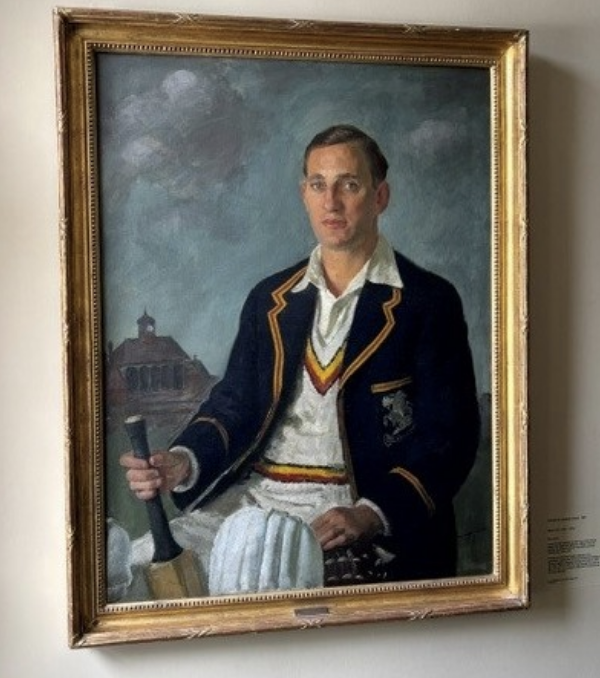
This 1951 portrait of Leonard Hutton by Henry Carr hangs in the Lord’s Pavilion, depicting the batsman in an MCC navy-blue touring blazer trimmed with MCC colours. Hutton was the first professional cricketer to captain England, playing in the Ashes-winning series in 1953 and again in 1954-55. In 1955, MCC amended its rules to allow Hutton, despite being a professional player, to become an Honorary Member.
Born in 1916, Hutton played for Yorkshire CCC between 1934 and 1955 and appeared in 79 Test matches. In only his sixth appearance in 1938, he scored 364 against Australia – a record that stood for almost 20 years. Indeed, it remains an England record many decades later.
Len Hutton was knighted in 1956 for his contributions to cricket. After retiring, he served as a Test selector, journalist and broadcaster. He became president of Yorkshire CCC in 1990, despite health issues and increasing frailty. In September 1990, he suffered a ruptured aorta and, after an unsuccessful operation, Sir Leonard Hutton died on 6 September.